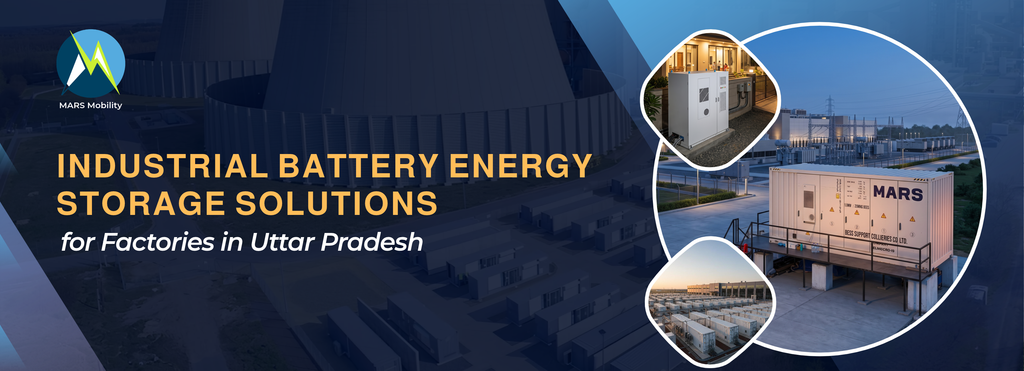
An industrial battery energy storage system in Uttar Pradesh helps a factory pay less for power, avoid costly stoppages and get more from its rooftop solar. UP’s time-of-day (ToD) tariff rewards plants that move power use from expensive hours to cheaper ones, and battery storage for factories is the simplest way to do that without changing production shifts. This guide explains how an industrial battery energy storage system in Uttar Pradesh pays its way, with a worked ToD example, sizing advice and the Kanpur-made range from Mars Energy & Mobility. For the state-wide picture, read our battery energy storage system in Uttar Pradesh guide.
Why UP Factories Are Adding Battery Storage Now
ToD pricing. Under the 2023 amendment to the Electricity (Rights of Consumers) Rules, commercial and industrial consumers with a maximum demand of 10 kW or more moved to time-of-day tariffs from 1 April 2024. In UP, the FY 2026-27 tariff order kept the existing ToD structure for industrial and commercial consumers, with a 15% rebate in cheaper hours and a 15% surcharge in costly ones.
Power is a major cost line. The average billing rate for FY 2026-27 is ₹7.97 per unit for large and heavy power (HV-2) consumers and ₹9.02 per unit for small and medium power (LMV-6) consumers, according to PowerPeak Digest’s summary of the UPERC order.
The state is building storage. UP’s renewable capacity reached 12.9 GW by June 2026, and Mercom reports an 860 MW solar-plus-storage pipeline, with C&I buyers moving toward storage-backed renewable power. In June 2026, UPERC also approved 1,130 MWh of grid-scale battery storage.
Industrial energy storage solutions are no longer a pilot project, and industrial battery storage solutions in India now come from local manufacturers too. An industrial battery energy storage system in Uttar Pradesh is now a tool for controlling a cost you pay every month. Planning an industrial battery energy storage system in Uttar Pradesh alongside new solar or a new connection also saves site work later.
Four Jobs an Industrial Battery Energy Storage System in Uttar Pradesh Does
Storage does four jobs in a plant:
- Shifting energy to cheaper hours. The battery charges in the rebate window and supplies the plant in the surcharge window. This is where an industrial battery energy storage system in Uttar Pradesh pays back under the state’s ToD tariff.
- Cutting peak demand. Motors, compressors and furnaces create short demand spikes. An industrial battery energy storage system supplies those spikes, so the plant draws less from the grid at its peak.
- Keeping production running. Mars says its C&I system keeps critical manufacturing lines and data centre equipment online during blackouts. For process plants, a short outage can mean scrapped batches and a long restart.
- Using more of your own solar. Factories with rooftop solar often produce more than they use around midday. Battery storage for factories stores that surplus for the evening shift. On smaller sites, a Mars hybrid inverter can link solar, battery and grid.
Which job matters most depends on your bill and your process. A well-designed industrial battery energy storage system in Uttar Pradesh usually does two or three of these jobs at once, with software deciding when to charge and discharge. Our C&I energy storage guide explains the components in detail.
The UP ToD Advantage: A Worked Example
UP’s ToD structure for industrial and commercial consumers in FY 2026-27 works like this:
| Season | 15% rebate | 15% surcharge |
| April to September | 7 AM to 4 PM | 7 PM to 2 AM |
| October to March | 10 PM to 4 AM | 6 AM to 10 AM, and 5 PM to 7 PM |
An industrial battery energy storage system in Uttar Pradesh charged in the rebate window pays 85% of the normal energy charge. Power it supplies in the surcharge window replaces power that would cost 115%. In winter, the morning surcharge follows straight after the night rebate, which suits plants that start work early.
Illustrative example. Say a plant shifts 200 kWh a day into the surcharge window. Using the 87% round-trip efficiency Mars lists for its containerised BESS, the battery needs about 230 kWh of charge to deliver 200 kWh.
- Cost to charge: 230 kWh at 85% = about 195.5 units of normal energy charge
- Cost avoided: 200 kWh at 115% = 230 units
- Daily saving: about 34.5 units, roughly 15% of what that energy would have cost in the surcharge window
Multiply by your energy charge and working days for a rupee figure. Peak cutting, fewer stoppages and solar use add to this.
Industrial energy storage solutions should be sized so the battery is fully used in the surcharge window. The right industrial battery energy storage system in Uttar Pradesh is planned around these windows and your shift pattern.
How to Size Battery Storage for Your Factory
Sizing an industrial battery energy storage system in Uttar Pradesh starts with data, not a catalogue. Collect:
- 12 months of electricity bills, with ToD-wise consumption if shown
- Peak demand in kVA or kW and when it occurs
- The loads that must never stop
- Rooftop solar or DG capacity, if any
- Space available indoors or outdoors
Then match your plant to a size band:
| Plant type | Typical need | Mars option |
| Small MSME units | Backup for critical loads, small ToD shift | Stackable Tower (4.8 to 21.3 kWh) or MB-ESS-LFP rack systems |
| Mid-size factories | Daily ToD shifting and peak cutting | C&I series (86 to 253 kWh configurations) or MBF200 (215 kWh to 2.58 MWh) |
| Large plants and industrial parks | MWh-scale shifting and solar storage | Containerised BESS (2.0 to 6.25 MWh) |
Battery storage for factories works best when it is sized for the job you care about most, then checked against the others. For most units, an industrial battery energy storage system in Uttar Pradesh is first sized for the surcharge window and then tested for backup. Good industrial battery storage solutions in India start with a load study, so ask for a site survey before any quote.
Mars Industrial Battery Storage Range, Made in Kanpur
Mars Energy & Mobility manufactures its C&I energy storage systems in Dada Nagar, Kanpur, so factories across the state can buy an industrial battery energy storage system in Uttar Pradesh from a supplier close at hand.
The C&I range, as listed by Mars:
- Indoor Series, Outdoor Units and the Powervault range, in 86 kWh to 253 kWh configurations
- Rack models MB-ESS-LFP-120V-280Ah, MB-ESS-LFP-240V-280Ah and MB-ESS-LFP-384V-100Ah, the MBF200 (215 kWh to 2.58 MWh) and the Stackable Tower (4.8 to 21.3 kWh)
- LFP cells for long cycle life and safety
- A proprietary Energy Management System engineered in-house, not third-party software
- IP54 protection, a working range of -20°C to 55°C, integrated thermal management and heptafluoropropane fire suppression
- A 10+ year lifespan, as stated by Mars
- A modular design, so capacity grows with your plant
This industrial battery energy storage system flattens the demand curve, reduces monthly demand charges and keeps critical lines running during blackouts. Mars delivers each industrial battery energy storage system through its four-step approach: site survey and energy analysis, custom design, installation and commissioning, then monitoring and maintenance.
Mars states that it commissioned the first utility-scale BESS in Telangana at SCCL, Mandamarri. In March 2025, IIT Kanpur signed an MoU with Mars Antennas & RF Systems Pvt Ltd to develop smart hybrid inverters and smart EV chargers for energy storage applications. For buyers comparing industrial battery storage solutions in India, a local factory, in-house software and that record make an industrial battery energy storage system in Uttar Pradesh from Mars easier to install, service and expand.
Safety and Installation Checklist for Factory Sites
Factories have heat, dust and heavy loads, so check these points before you sign:
- Fire suppression: built in, with thermal detection
- Protection rating: IP54 or higher for dusty or outdoor locations
- Temperature range: confirmed for UP summers, with any derating stated in writing
- BMS protection: overcharge, over-discharge, short circuit, over-temperature and overload
- Service: a local team, spares and remote monitoring
Battery storage for factories should also sit away from process heat, with clear access for maintenance. Industrial energy storage solutions from a manufacturer with a nearby service team get faster attention when something needs fixing. Every industrial battery energy storage system in Uttar Pradesh should meet each point on this list.
Frequently Asked Questions
Does UP’s ToD tariff apply to my factory?
National rules apply ToD to C&I consumers with a maximum demand of 10 kW or more. Check your tariff category on your bill.
How much can an industrial battery energy storage system save?
It depends on how much energy you shift, your tariff and your solar use. The ToD spread alone is 30 percentage points of the normal energy charge, before losses.
Can it replace a DG set?
It can cover short outages and critical loads. Long outages need a system sized for that duration.
Is LFP safe for factories?
LFP is among the most thermally stable lithium chemistries. Safety also depends on the BMS, cooling and fire suppression.
Who makes an industrial battery energy storage system in Uttar Pradesh?
Mars Energy & Mobility manufactures industrial energy storage solutions in Kanpur. Contact the team or call +91-7991262620.
