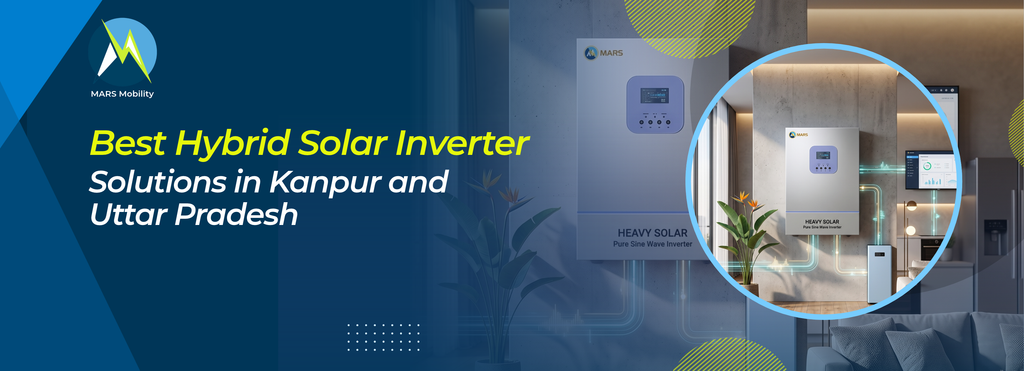
A hybrid solar inverter in Uttar Pradesh lets a home, shop or office run on solar in the day, store the surplus in a battery and keep the lights on during a power cut. As rooftop solar spreads across the state, more buyers want one box that manages solar, battery and grid together. This guide shows how to size a hybrid solar inverter in Uttar Pradesh, how to match it to the right battery, and what subsidy and tariff rules mean for you. It also covers the solar inverter with battery storage range made in Kanpur by Mars Energy & Mobility.
Why Hybrid Inverters Are Growing Fast in Uttar Pradesh
Rooftop solar in UP has moved into the mainstream. According to SolarQuarter (10 July 2026), the state has installed more than 6.50 lakh rooftop solar systems under PM Surya Ghar Muft Bijli Yojana, with about 2,350 MW of rooftop capacity, with UPNEDA as the implementing agency.
Many of these homes and businesses now want backup and evening use from their solar, not just lower daytime bills. That is the job of a solar hybrid inverter. Tariffs push in the same direction. Commercial and industrial consumers with a maximum demand of 10 kW or more are on time-of-day tariffs, and UP’s tariff order gives a 15% rebate from 7 AM to 4 PM between April and September and a 15% surcharge from 7 PM to 2 AM. A hybrid solar inverter in Uttar Pradesh can store cheap midday solar and use it in those costly evening hours. For larger sites, our battery energy storage guide for Uttar Pradesh covers the bigger picture, and a hybrid solar inverter in Uttar Pradesh is often the first step towards it.
What a Hybrid Solar Inverter in Uttar Pradesh Does for You
A hybrid inverter converts solar DC power into AC for your loads, charges a battery with surplus solar and draws from the grid when needed, all from one unit. During a power cut, it switches to battery and solar so essential loads keep running.
In short, a solar inverter with battery storage gives you three things: lower bills, backup and more use of your own solar. For a full comparison with an ordinary grid-tied unit, read our guide on hybrid solar inverter vs normal solar inverter. A hybrid solar inverter in Uttar Pradesh is especially useful where power cuts and evening peaks are common.
Choosing the Right Size for Homes, Shops and Businesses
Size depends on the loads you want to run at the same time and how long you need backup. Use these as starting points, then confirm with a load survey:
| Who | Typical loads | Mars model to consider |
| Small home | Lights, fans, fridge, TV, Wi-Fi | 2 kW or 3.3 kW (24V) |
| Larger home | The above plus a pump or an AC | 4 kW (24V) or 5.5 kW (48V) |
| Shop, clinic or restaurant | Lighting, billing, refrigeration, small machines | 5.5 kW or 8.6 kW (48V) |
| Office or small business | Computers, servers, lighting, AC | 10 kW (384-700V) |
Backup hours. Battery size decides how long the backup lasts. As a rough guide, multiply the load you want to run by the hours of backup you need. Running 1 kW of essential loads for 4 hours needs about 4 kWh of usable storage, which one 48V 4.8 kWh Mars battery can cover with a small margin, depending on usable capacity. When you plan a hybrid solar inverter in Uttar Pradesh, decide the backup hours first, then pick the solar hybrid inverter and battery together.
For a shop or office, a commercial hybrid solar inverter should be sized for the loads that must run during a cut, not for every appliance. A commercial hybrid solar inverter in the 8.6 kW or 10 kW class suits most small businesses. If your site needs more than 10 kW of backup or wants to shift large loads between tariff windows, look at a C&I battery system instead of a single solar hybrid inverter.
Picking the right hybrid solar inverter in Uttar Pradesh also means checking your solar array. The panel string voltage must sit within the inverter’s MPPT range, so ask your installer to confirm the string design before you buy. An undersized hybrid solar inverter in Uttar Pradesh may trip under load, while an oversized one wastes money.
Match the Inverter to the Battery
A frequent buying mistake is pairing an inverter and battery that do not share the same system voltage. A solar inverter with battery storage only works well when both are designed for the same voltage and can talk to each other. Here is how the Mars range pairs:
| Mars inverter | System voltage | Mars battery to pair |
| 2 kW, 3.3 kW, 4 kW | 24V | 25.6V 100Ah (2.5 kWh) wall-mount LFP battery |
| 5.5 kW, 8.6 kW | 48V | 48V 100Ah (4.8 kWh) wall-mount LFP battery, or the Stackable Tower (4.8 to 21.3 kWh) |
| 10 kW | 384-700V | High-voltage LFP battery (confirm the pairing with Mars) |
Mars wall-mount batteries use LFP cells, offer usable energy from 2.56 kWh to 20 kWh with parallel modules, and include CAN and RS485 ports for monitoring and integration with hybrid inverters. Buying the solar hybrid inverter and battery from the same manufacturer makes this matching simple. A matched solar inverter with battery storage also makes warranty and service easier, because one supplier owns the whole system. Getting the battery right is half the value of a hybrid solar inverter in Uttar Pradesh.
Mars Hybrid Inverter, Made in Kanpur
Mars Energy & Mobility designs its hybrid inverter range in Kanpur for residential, commercial and industrial use. Mars lists its typical applications as residential solar systems, small offices, shops, telecom loads and rooftop solar installations across Kanpur and Uttar Pradesh, which makes it a natural hybrid solar inverter in Uttar Pradesh for local buyers.
Key features, as listed by Mars:
- Six models: 2 kW, 3.3 kW and 4 kW at 24V, 5.5 kW and 8.6 kW at 48V, and 10 kW at 384-700V
- Pure sine wave output at 220V, 230V or 240V, with up to 94% efficiency
- Integrated MPPT to extract maximum solar energy
- Transformerless design for a compact, lighter unit
- Fast switching between grid, solar and battery
- Dual battery compatibility, so you can choose storage that fits your budget
- Works with inverter and UPS loads, with a built-in manual bypass switch for safe servicing
- DSP-based battery level management and low-voltage support for stable output when grid or battery voltage drops
- Wall-mounted, IP20, so it should be installed indoors
There is also strong engineering behind the product. On 17 March 2025, IIT Kanpur signed an MoU with Mars Antennas & RF Systems Pvt Ltd to design, develop and test smart hybrid inverters for energy storage applications. For shop owners, a commercial hybrid solar inverter backed by that research and a Kanpur factory means local support. For homes, it means a hybrid solar inverter in Uttar Pradesh from a manufacturer within reach. A Mars commercial hybrid solar inverter can also be paired with Mars LFP batteries for a single-source system.
Subsidy, Net Metering and ToD: What UP Buyers Should Know
Subsidy for homes. If you are buying a hybrid solar inverter in Uttar Pradesh for your home, note that under PM Surya Ghar, the central subsidy for residential rooftop solar is ₹30,000 per kW for the first 2 kW, ₹18,000 per kW for the third kW, and capped at ₹78,000 for systems above 3 kW, as listed on the Delhi Solar Portal. UP may offer additional state support, so check current rates and eligibility for your setup on the official PM Surya Ghar portal or with UPNEDA before you buy.
Net metering. UPERC’s rooftop solar regulations govern how exported solar is credited. The third amendment took effect on 5 July 2025 and revised the solar injection compensation, so confirm the current terms with your discom.
ToD for businesses. A commercial hybrid solar inverter with storage can charge in the rebate window and supply power in surcharge hours, reducing the bill further. A solar inverter with battery storage therefore pays back faster on a ToD connection. Factor this in when you compare a hybrid solar inverter in Uttar Pradesh with a cheaper grid-tied unit.
Frequently Asked Questions
Can a hybrid inverter work without a battery?
Many hybrid inverters can run with solar and grid alone, and a battery can be added later. Check the model specification before you buy.
What size hybrid inverter do I need for my home?
Most small homes start at 2 kW to 3.3 kW, and larger homes with a pump or AC need 4 kW to 5.5 kW. A load survey gives the exact size.
Which battery works best with a solar hybrid inverter?
An LFP battery at the same system voltage, with CAN or RS485 communication, is the safest match.
Is the PM Surya Ghar subsidy available for hybrid systems?
The subsidy is for residential rooftop solar. Check eligibility for your exact configuration on the official portal.
Where can I buy a hybrid solar inverter in Uttar Pradesh?
Mars Energy & Mobility makes its range in Kanpur.
Contact the team or call +91-7991262620.
