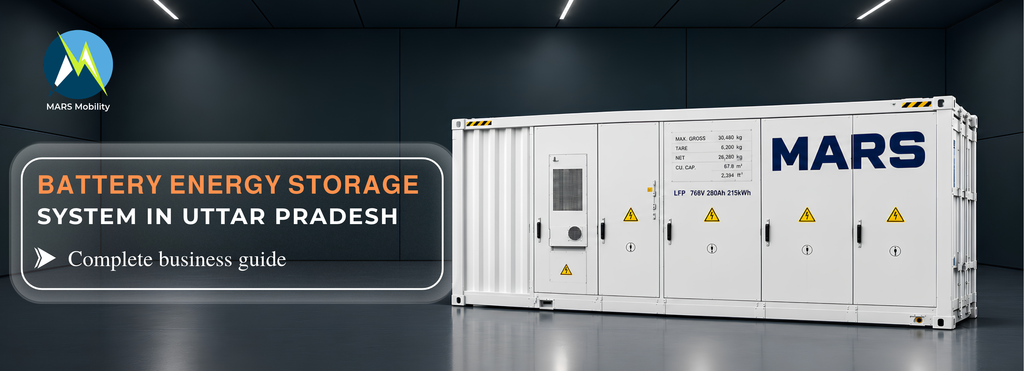
A battery energy storage system in Uttar Pradesh is no longer only a utility project. It is now a business decision. Factories, hospitals, offices and commercial buildings across the state want steadier power, lower demand charges and more value from their rooftop solar. This guide explains what a battery energy storage system in Uttar Pradesh can do for your site, what is driving demand in the state, and how to pick the right battery energy storage solutions for your load. It also covers the Kanpur-made systems from Mars Energy & Mobility, a manufacturer based in Dada Nagar, Kanpur.
What Is a Battery Energy Storage System?
A battery energy storage system (BESS) is a set of rechargeable batteries, a battery management system (BMS), a power conversion system and control software that stores electricity and releases it when needed. It does not generate power. It moves power from the time it is available to the time it is needed.
For a business, that means three things: backup during outages, lower bills by cutting peak demand, and solar power stored for use after sunset. A battery energy storage system in Uttar Pradesh works on the same principle as anywhere else. What changes is the tariff, the grid and the local demand. For a deeper look at the technology, read our guide on what a BESS is and how it works.
Why Businesses Need a Battery Energy Storage System in Uttar Pradesh
According to Mercom (28 September 2026), the state’s renewable capacity reached 12.9 GW by June 2026, and solar alone stood at 7 GW. Solar produces power in daylight, but many plants run evening shifts and face outages and demand peaks outside solar hours. Storage closes that gap.
The shift is visible at three levels:
- Utilities. On 16 June 2026, the state regulator UPERC approved a joint plan by UPPCL and MPPMCL to procure 1,130 MWh of four-hour battery storage for 15 years, with Uttar Pradesh using the system from May to October.
- Industry. Mercom reports 2.3 GW of solar open access capacity in UP and an 860 MW solar-plus-storage pipeline, with commercial and industrial buyers moving toward storage-backed renewable power.
- Individual sites. An industrial energy storage system lets a single factory do the same thing at a smaller scale: store solar or off-peak power and use it when power costs more or the grid fails.
For many sites, a battery energy storage system in Uttar Pradesh now belongs in the same conversation as rooftop solar and open access. Planning a battery energy storage system in Uttar Pradesh early avoids paying twice for site work later.
Where a BESS Fits for UP Businesses
Use this table as a starting point:
| Site type | Main problem | What storage does | Typical Mars system |
| Factories and MSMEs | Demand charges, production stops during outages | Cuts peaks, keeps critical lines running | Industrial energy storage system (C&I range) |
| Hospitals and data rooms | Equipment that cannot go down | Keeps critical equipment online during outages | C&I system |
| Malls, offices and hotels | High daytime bills, generator noise and fuel | A commercial battery storage system stores solar and covers peaks | C&I system or wall-mounted battery |
| Solar plants and large campuses | Surplus daytime power | Stores and shifts output at MWh scale | Containerised BESS |
A commercial battery storage system and a factory system use the same building blocks. The difference is size, duty cycle and how often it charges and discharges each day. Our C&I energy storage guide covers this in detail. Whatever the site, a battery energy storage system in Uttar Pradesh should be sized from real load data, not guesswork. A quick look at your last year of bills usually shows whether peak shaving, backup or solar storage gives the best return, and a good battery energy storage system in Uttar Pradesh is designed around that answer.
Mars C&I Energy Storage System: Built in Kanpur for UP Businesses
Mars Energy & Mobility designs and manufactures its Commercial & Industrial (C&I) Energy Storage System in Kanpur. It is built for businesses that want a battery energy storage system in Uttar Pradesh with engineering support close at hand.
What it offers, as listed by Mars:
- Range: Indoor Series, Outdoor Units and the Powervault range, in configurations from 86 kWh to 253 kWh. The MBF200 model scales from 215 kWh up to 2.58 MWh.
- Chemistry: Lithium iron phosphate (LFP) cells, chosen for long cycle life and safety.
- Self-developed EMS: The Energy Management System is engineered in-house by Mars instead of relying on third-party software. It gives real-time monitoring and automated control.
- Built for tough conditions: IP54 protection, a working temperature range of -20°C to 55°C, integrated thermal management and heptafluoropropane fire suppression.
- Life: Mars states a 10+ year lifespan, supported by its integrated thermal management.
- Modular design: Capacity can be added as your load grows.
In daily use, this commercial battery storage system flattens the demand curve, reduces monthly demand charges and keeps critical manufacturing lines and data centre equipment online during blackouts. As an industrial energy storage system, it works alongside solar, inverters, UPS systems and wind power. For a plant with a heavy morning start-up load, a correctly sized industrial energy storage system can take that peak off the grid connection.
Mars also funds research close to home. In March 2025, IIT Kanpur signed an MoU with Mars Antennas & RF Systems Pvt Ltd to design, develop and test smart hybrid inverters and smart EV chargers for energy storage applications. For UP buyers, that means a commercial battery storage system backed by a Kanpur factory and local engineering, which makes a battery energy storage system in Uttar Pradesh easier to install, service and expand.
Containerised BESS for Large Sites
For solar parks, large campuses and utility-linked projects, Mars offers containerised battery energy storage solutions in 20 ft and 40 ft formats:
- Energy capacity of 2.0 MWh to 6.25 MWh and rated AC power of 0.5 MW to 2.5 MW, depending on configuration
- Round-trip efficiency of 87% or higher
- IP55 outdoor rating and an operating range of -20°C to 50°C (derated above 45°C)
- Integrated HVAC with BMS-controlled forced air cooling, and aerosol-based fire suppression with thermal detection
- RS485, CAN and Ethernet (Modbus RTU/TCP) communication
These battery energy storage solutions follow a four-step approach: site assessment and energy analysis, customised system design, integration and commissioning, then performance monitoring and maintenance. Mars states that it commissioned the first utility-scale BESS in Telangana at SCCL, Mandamarri. For buyers planning a MWh-scale battery energy storage system in Uttar Pradesh, that project record matters as much as the specification sheet. See the full BESS range.
How to Choose a BESS Supplier in Uttar Pradesh
Ask every supplier of a battery energy storage system in Uttar Pradesh these questions, and get the answers in writing:
- Chemistry and cycle life. How many cycles, at what depth of discharge, and how much capacity remains at end of life?
- BMS protection. Does it cover overcharge, over-discharge, short circuit, over-temperature and overload?
- EMS ownership. Is the software developed in-house or licensed? Who fixes it if something goes wrong?
- Thermal and fire safety. What cooling and fire suppression is built in?
- Site survey. Will they study your load profile and power quality before sizing?
- Local service. How far is the service team from your site, and how fast can they respond?
- Warranty and test reports. Are performance terms written down?
A supplier who answers all seven clearly is more likely to deliver battery energy storage solutions that work for years, whether you need a small commercial battery storage system or a multi-MWh project. A manufacturer inside the state also shortens the path between a fault and a fix for any battery energy storage system in Uttar Pradesh.
What Decides the Cost of a BESS
There is no single price. Cost depends on capacity (kWh), power rating (kW), chemistry, indoor or outdoor installation, cooling and fire safety, and site work. An industrial energy storage system built for peak shaving is sized differently from one built for full backup.
For an accurate quote, share your last 12 months of electricity bills, peak demand in kW, a list of critical loads, existing solar or DG capacity and the space available. The right battery energy storage system in Uttar Pradesh is sized from this data.
Talk to Mars Energy & Mobility.
Call +91-7991262620, email info@marsmobility.in or send an enquiry.
Frequently Asked Questions
Is a battery energy storage system useful without solar?
Yes. It can charge from the grid and still provide backup and peak shaving.
How long does a BESS last?
It depends on chemistry, usage and temperature. Mars states a 10+ year lifespan for its C&I systems.
Is LFP safe for factories?
LFP is one of the most thermally stable lithium chemistries. Safety also depends on the BMS, cooling and fire suppression.
Can one system run a whole factory?
Usually storage covers critical loads or peak demand, not the full plant. The right size comes from your load data.
Where can I buy a battery energy storage system in Uttar Pradesh?
From a manufacturer with local service. Mars Energy & Mobility builds battery energy storage solutions in Kanpur and supplies businesses across India.
Talk to Mars Energy & Mobility. Call +91-7991262620, email info@marsmobility.in or send an enquiry.
