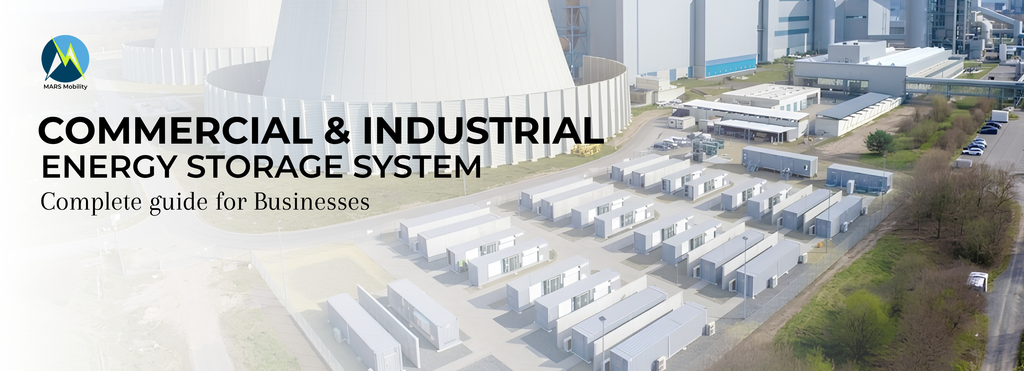
Electricity directly affects production, equipment performance, customer service and business continuity. A commercial energy storage system gives businesses more control over when and how electricity is used. Instead of depending only on the grid, a company can store power and use it during peak demand, outages or periods when electricity is more expensive.
For large facilities, storage can support better power management, solar integration and reliable operations. This guide explains how commercial and industrial battery storage works, where it is used, how it is sized and what businesses should check before investing.
What Is a Commercial Energy Storage System?
A commercial energy storage system is a battery-based solution that stores electricity for later use in commercial and industrial facilities. The electricity may come from the grid, rooftop solar or another renewable source.
Unlike a basic backup battery, a modern C&I energy storage system is designed to manage energy throughout the day. It can charge when electricity is available or cheaper and discharge when demand rises or when power supply is interrupted.
A typical system includes battery modules, a Battery Management System, a Power Conversion System, an Energy Management System, cooling and safety systems.
An industrial energy storage system usually operates at a larger scale and may support production lines, motors and other high-load applications.
Why Businesses Are Investing in Energy Storage
As operations become more automated and electricity-dependent, peak demand, tariff changes and grid interruptions can have a larger impact on operating costs.
A commercial energy storage system helps a business use electricity more strategically by reducing grid draw during selected high-demand periods.
This is especially useful with rooftop solar, which may generate more electricity during daytime hours than a facility can immediately use. Battery storage for business allows excess solar electricity to be stored and used later.
Time-of-Day tariffs can also make the timing of electricity use more important. Energy storage can support load shifting by charging during lower-cost periods and discharging during more expensive periods.
How Does a C&I Energy Storage System Work?
A C&I energy storage system works through four main stages.
1. Charging
The battery charges from the grid, solar panels or another source. Charging can be scheduled around prices, solar output or operating needs.
2. Storing Energy
The batteries hold electricity until needed while the BMS monitors voltage, temperature, state of charge and battery condition.
3. Energy Management
The Energy Management System decides when the battery should charge or discharge, which separates a basic backup battery from a modern commercial energy storage system.
4. Discharging
When electricity demand increases, solar generation falls or the grid fails, the system can supply stored energy to the facility.
This process makes commercial battery storage useful not only during outages but also during normal daily operations.
Main Components of a Commercial Energy Storage System
A modern commercial energy storage system combines several connected components.
Battery modules store electricity. Lithium Iron Phosphate, or LFP, is widely used because of its long cycle life and thermal stability.
- Battery Management System
The BMS tracks voltage, current, temperature and state of charge to help the battery operate safely.
The PCS converts electricity between DC battery power and the AC power used by most facilities.
The EMS controls charging and discharging. A well-designed C&I energy storage system can use the EMS to respond to load patterns, solar generation and energy-management goals.
Cooling systems help maintain suitable battery operating temperatures.
Commercial systems may include fire detection, protection devices and alarms depending on the design.
Benefits of Commercial Energy Storage for Businesses
A commercial energy storage system can support both financial and operational goals. The actual benefit depends on the tariff, load profile, operating hours and system design.
During short periods of high electricity demand, the battery can discharge and reduce the power drawn from the grid.
This is known as peak shaving. Where demand charges apply, reducing the peak can potentially lower electricity costs.
A business can charge the battery during lower-cost periods and use stored electricity during higher-cost periods. This approach can improve the economics of battery storage for businesses where Time-of-Day tariffs or similar pricing structures apply.
- Better Use of Rooftop Solar
A business with rooftop solar may generate more electricity than it can use during certain hours. A commercial energy storage system can store that excess solar power and make it available later. This can increase solar self-consumption and reduce grid purchases.
Power interruptions can stop production and affect customer service. Commercial battery storage can support selected loads during outages, depending on battery capacity and system configuration.
- Lower Dependence on Diesel Generators
Where suitable, storage can reduce generator use during short outages or temporary peaks.
An EMS gives facility managers better visibility and control over charging, discharging and renewable-energy use.
A modular storage platform can often be expanded as electricity demand increases. This gives growing businesses more flexibility.
Major Commercial and Industrial Energy Storage Applications
The best use case depends on the facility and its electricity profile.
Factories often have motors, production lines and machinery that create high or changing loads. An industrial energy storage system can support peak management, power continuity and renewable integration.
- Warehouses and Logistics Centres
Warehouses may combine lighting, HVAC, automation, charging and cold-storage loads. A commercial energy storage system can help manage these loads and improve solar utilisation.
Offices, shopping centres, hotels and large institutions can use commercial battery storage to support peak shaving, backup power and load shifting.
Data centres require stable power and strong backup architecture. Battery storage can be integrated as part of a wider energy-management strategy, although it should not be assumed to replace every UPS or emergency-power requirement.
- Hospitals and Healthcare Facilities
Healthcare facilities depend on continuous electricity. Storage can support selected critical loads as part of a properly engineered backup system.
For companies with rooftop solar, battery storage for business can store excess daytime generation and make it available in the evening or during low-solar periods.
- EV Charging Infrastructure
Fast EV charging can create high demand. A commercial energy storage system can help reduce grid peaks by supplying part of the charging load from stored energy.
Commercial Energy Storage vs Traditional Backup Batteries
Traditional backup batteries mainly provide power when the grid fails. A modern commercial energy storage system has a broader role.
| Feature | Traditional Backup Battery | C&I Energy Storage |
| Main purpose | Emergency backup | Energy management and backup |
| Peak shaving | Usually limited | Yes, when configured |
| Load shifting | Limited | Yes |
| Solar integration | Basic or limited | Designed for integration |
| Monitoring | Basic | Advanced BMS and EMS |
| Scalability | Often limited | Usually modular |
| Daily optimisation | Limited | Designed for active management |
A C&I energy storage system can therefore operate every day instead of remaining unused until an outage occurs.
This is why modern storage should be evaluated as an energy-management investment, not simply as a larger backup battery.
How Is a Commercial Energy Storage System Sized?
A commercial energy storage system should be sized according to the site’s real power and energy requirements.
Two measurements are especially important:
kW measures power. It shows how much electricity the system can deliver at one moment.
kWh measures energy. It shows how much electricity the battery can store and therefore helps determine how long it can support a load.
Businesses should review:
- Maximum demand
- Daily electricity consumption
- Load profile
- Peak duration
- Critical equipment
- Required backup time
- Rooftop solar capacity
- Electricity tariff
- Available installation space
- Future expansion plans
A factory with high daily consumption does not automatically need a battery equal to its full daily use. If the goal is peak shaving, the battery may only need to cover specific demand spikes.
Industrial storage should therefore be sized after studying actual interval load data and operating conditions.
What Determines the ROI of Commercial Battery Storage?
The return on investment is different for every business.
Important factors include tariffs, demand charges, Time-of-Day rates, system cost, capacity, power rating, solar generation, utilisation and financing.
Round-trip efficiency should also be included in financial modelling because some energy is lost during charging and discharging.
Battery degradation and cycle life matter because daily load shifting creates a different usage pattern from occasional backup.
Avoided downtime can also add value, especially where an outage can stop production.
A commercial energy storage system should therefore be evaluated using the site’s actual bills, load data and operational requirements rather than generic payback claims.
How to Choose the Right C&I Energy Storage System
Choosing a commercial energy storage system requires more than comparing battery capacity or price per kWh.
Businesses should evaluate:
LFP batteries are widely used because of their cycle life and thermal characteristics.
- Power and Energy Capacity
The system needs enough kW for the load and enough kWh for the required duration.
Cycle life affects how long the battery may remain useful under the expected charging and discharging pattern.
- Battery Management System
The BMS should monitor and protect the battery modules.
The EMS should respond to electricity prices, solar production and facility demand.
- Thermal and Safety Design
Cooling, enclosure protection, fire detection and system safety should match the installation environment.
- Communication and Monitoring
Modern systems should provide suitable communication and monitoring.
A scalable storage system can be expanded as the business grows.
Installation, commissioning and after-sales support also matter. Businesses should avoid choosing a storage system only by comparing the lowest initial price. Long-term performance, safety and service support can be equally important.
Mars Energy C&I Energy Storage Solutions
Mars Energy & Mobility develops LFP-based systems for commercial and industrial applications. Its commercial energy storage system portfolio is designed for businesses that need renewable integration, peak-demand management, backup support and scalable energy infrastructure.
Mars offers modular C&I configurations in the approximately 86 kWh to 253 kWh range, depending on system design. Its larger configurations include systems around 215 kWh to 253 kWh.
The solutions use LFP technology with energy-management and battery-control systems. Mars also highlights its in-house Energy Management System, which supports smarter charging and discharging decisions.
Depending on configuration, the systems support communication such as Ethernet and RS485 and use air or liquid thermal management. Operating ranges on current specifications extend from approximately -20°C to 55°C.
These capabilities allow an industrial energy storage system to support factories, commercial facilities and renewable-energy integration.
Frequently Asked Questions
What is a commercial energy storage system?
A commercial energy storage system stores electricity and supplies it later according to a business’s energy requirements. It can support peak shaving, load shifting, rooftop solar, backup power and daily energy management.
How can battery storage reduce a business’s electricity costs?
Energy storage may reduce electricity costs by lowering peak grid demand, shifting electricity consumption to different tariff periods and increasing the use of on-site solar energy. Actual savings depend on tariffs, load patterns and system operation.
What size battery does a commercial business need?
The correct size depends on maximum demand, critical loads, peak duration, solar generation and required backup time. A load assessment should be completed before choosing capacity.
Can commercial battery storage work with rooftop solar?
Yes. The battery can store excess rooftop-solar electricity during the day and supply it later when generation falls or electricity demand increases.
What is the difference between commercial and industrial energy storage?
Commercial storage commonly serves offices, hotels and retail facilities. An industrial energy storage system usually handles larger loads, production machinery and more complex operating requirements. However, both use similar battery, BMS, PCS and EMS technologies.
Conclusion
A commercial energy storage system gives businesses greater control over electricity use. It can support peak shaving, load shifting, solar integration, backup power and smarter energy management.
The right system depends on the site’s electricity profile, tariff, operating schedule and future needs. Businesses should consider power rating, energy capacity, battery chemistry, EMS capability, safety, scalability and technical support before investing.
For companies evaluating battery storage for business, a properly designed storage solution can become an important part of a more reliable and flexible energy strategy.
