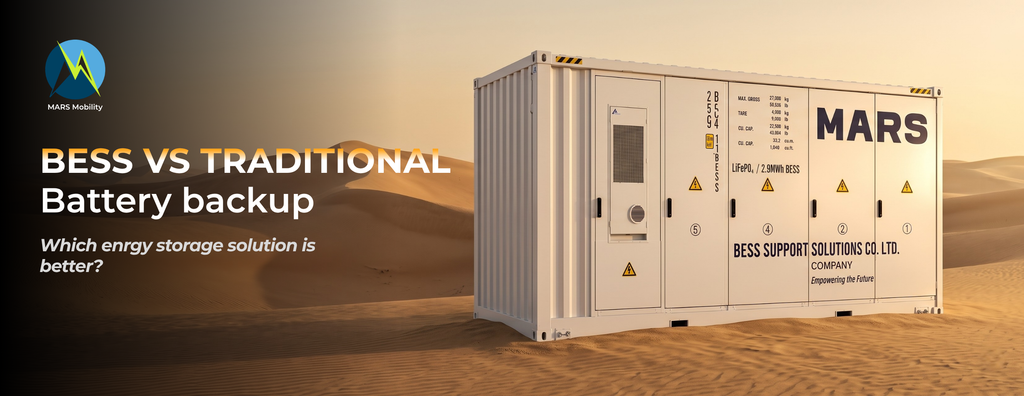
If you’re exploring backup power options for your home or business, you’ve likely come across two very different-sounding solutions: a traditional battery backup (the kind that’s powered Indian homes and offices for decades) and a modern Battery Energy Storage System, or BESS. On the surface, they seem to do the same job, storing power for later use. But under the hood, they’re built quite differently, and that difference matters a lot when it comes to performance, cost, and long-term reliability.
In this guide, we’ll break down BESS vs battery backup in simple terms, so you can decide which energy storage solution actually makes sense for your needs.
What Is a Battery Energy Storage System (BESS)?
A Battery Energy Storage System is a modern, engineered setup that stores electricity using advanced battery chemistry, most commonly Lithium Iron Phosphate (LFP), combined with a Battery Management System (BMS), an inverter or Power Conversion System, and often an Energy Management System (EMS) for smart charging and discharging.
A BESS isn’t just a battery sitting in a box. It’s a complete, intelligent system designed to store solar or grid power, manage it efficiently, and release it exactly when needed, whether that’s during a power cut, peak demand hours, or to support renewable energy integration.
What Is Traditional Battery Backup?
Traditional battery backup refers to the older, more familiar setup most Indian households and small businesses have relied on for years: typically a lead-acid battery paired with a basic inverter. When the grid goes down, the inverter switches to battery power, keeping essential appliances like lights and fans running until the power returns.
This setup has worked reasonably well for basic needs, but it comes with real limitations: shorter battery life, frequent maintenance (like topping up water levels), lower efficiency, and limited capacity for scaling up as power needs grow.
BESS vs Battery Backup: Key Differences at a Glance
| Feature | BESS (Modern) | Traditional Battery Backup |
| Battery Chemistry | Lithium-ion / LFP | Lead-acid |
| Lifespan | 10+ years, 6,000+ cycles | 3-5 years, 300-500 cycles |
| Efficiency | 90-95% | 70-80% |
| Maintenance | Minimal | Regular (water topping, corrosion checks) |
| Scalability | Modular, easy to expand | Limited, often requires full replacement |
| Smart Features | BMS, EMS, app monitoring | None or very basic |
| Solar Integration | Seamless, built for it | Limited, often needs extra equipment |
| Space Required | Compact | Bulky, heavier footprint |
| Upfront Cost | Higher | Lower |
| Long-Term Cost | Lower overall | Higher (frequent replacements) |
As the table shows, a Battery Energy Storage System costs more initially, but it’s built for a fundamentally different level of performance, longevity, and intelligence than a basic backup setup.
Technology: Why the Battery Chemistry Matters
This is really where the two solutions diverge the most. Traditional battery backup relies on lead-acid technology, which is well understood but chemically limited: it degrades faster, loses efficiency as it ages, and requires regular upkeep to stay functional.
A modern BESS, on the other hand, typically uses lithium-ion or LFP cells. LFP in particular has become the preferred chemistry across Indian commercial battery storage and industrial energy storage system installations, mainly because it handles high temperatures better and carries a much lower risk of thermal issues, an important factor given India’s climate.
Performance Comparison
Charging Speed A BESS generally charges significantly faster than a lead-acid-based battery backup system, which matters if you’re pairing it with solar and want to capture as much daytime generation as possible.
Backup Duration & Capacity Traditional battery backup is usually designed for short-duration, essential-load backup, think a few lights and a fan for a couple of hours. A BESS, especially in commercial battery storage or industrial energy storage system configurations, can be scaled to power entire operations for extended periods, and modular designs make it easy to add capacity later without replacing the whole system.
Efficiency Lead-acid systems typically operate at 70-80% round-trip efficiency, meaning a meaningful chunk of stored energy is lost. A BESS using lithium technology usually reaches 90-95% efficiency, translating directly into better value from every unit of electricity stored.
Smart Monitoring Most modern BESS installations include app-based monitoring, real-time diagnostics, and automated charge/discharge scheduling. Traditional battery backup systems generally offer none of this, you simply find out something’s wrong when the backup fails to kick in.
Safety Comparison
Safety is another area where the gap between these two energy storage solutions is significant. Traditional lead-acid battery backup systems can release hydrogen gas during charging, require adequate ventilation, and carry risks like acid leakage or corrosion over time if not maintained properly.
A modern Battery Energy Storage System, particularly one built on LFP chemistry, is designed with safety as a core feature rather than an afterthought. The built-in Battery Management System continuously monitors for overcharging, short circuits, deep discharge, and overheating, automatically taking corrective action before any of these become a real hazard. This is one of the main reasons commercial battery storage and industrial energy storage system installations have increasingly shifted toward lithium-based BESS technology over the past few years, the risk profile is simply far lower.
Environmental Impact
There’s also a sustainability angle worth considering when comparing BESS vs battery backup. Lead-acid batteries contain toxic materials and require careful disposal or recycling to avoid environmental contamination. They also need replacing far more frequently, meaning more manufacturing, transport, and waste over the same period of use.
A Battery Energy Storage System built on LFP chemistry is generally considered more environmentally friendly: it lasts significantly longer (reducing the frequency of replacement and waste), doesn’t contain the same toxic heavy metals as older lead-acid designs, and pairs naturally with renewable energy sources like solar and wind, supporting a broader shift toward cleaner energy storage solutions in India.
Cost Comparison: Upfront vs Long-Term
This is often the deciding factor for buyers, so it’s worth being upfront about it: a Battery Energy Storage System does cost more initially than a basic lead-acid battery backup setup.
However, when you look at the full picture:
- A lead-acid battery backup typically needs replacing every 3-5 years, sometimes sooner with heavy use.
- A quality BESS, especially LFP-based, is built to last 10+ years, meaning you avoid multiple replacement cycles over the same period.
- Maintenance costs for traditional battery backup (water top-ups, corrosion checks, capacity testing) add up over time, while a BESS with a proper BMS needs very little ongoing attention.
When calculated as a cost-per-year over a decade, energy storage solutions in India built around modern BESS technology very often come out ahead financially, even though the sticker price looks higher on day one.
Applications: Where Each Solution Fits Best
Traditional Battery Backup Still Makes Sense For:
- Very basic residential backup needs (a few lights and fans during short outages)
- Extremely budget-constrained situations where upfront cost is the only priority
- Short-term or temporary setups where long-term value isn’t a major concern
A BESS Is the Better Fit For:
- Homes wanting reliable, longer backup with solar integration
- Businesses needing commercial battery storage to manage peak demand charges
- Factories and facilities requiring a dependable industrial energy storage system for continuous operations
- Anyone planning to scale their power storage needs over time
- Applications where safety, efficiency, and low maintenance matter more than the lowest possible upfront cost
Which Should You Choose?
If your only requirement is a very basic, short-duration backup and budget is extremely tight, traditional battery backup can still technically get the job done. But for almost everyone else, homeowners wanting real energy independence, businesses looking to cut peak demand costs, or industries needing dependable backup for critical operations, a Battery Energy Storage System is the more future-proof choice.
India’s broader shift toward renewable energy and grid modernization is also accelerating this transition. As more homes and businesses adopt solar, and as electricity tariffs continue to rise during peak hours, the gap between what a basic battery backup can offer and what a modern BESS delivers is only going to widen further.
Mars Energy: Modern BESS Solutions Built for India
At Mars Energy & Mobility, we manufacture Battery Energy Storage Systems designed specifically to outperform traditional battery backup, from compact home battery storage units, to full commercial battery storage solutions for businesses, to large-scale containerized BESS for industrial and grid-scale applications.
Every system we build uses LFP battery technology, an in-house Battery Management System, and is manufactured in Kanpur, Uttar Pradesh under the Make in India initiative, giving you a genuine energy storage solution rather than a basic backup that needs replacing every few years.
Contact our team to discuss whether a BESS is the right upgrade for your home or business.
Frequently Asked Questions
Is BESS better than a traditional battery backup? For most homes and businesses, yes. A BESS offers longer lifespan, higher efficiency, lower maintenance, and better solar integration compared to traditional lead-acid battery backup, even though the upfront cost is higher.
Can I upgrade from a traditional battery backup to a BESS? Yes, most homes and businesses can transition to a modern Battery Energy Storage System. It’s best to consult a manufacturer who can assess your existing setup and recommend the right capacity and configuration.
Why is BESS more expensive than traditional battery backup? A BESS uses more advanced lithium-based battery chemistry, an intelligent Battery Management System, and often additional smart features, all of which cost more to manufacture than a basic lead-acid battery and inverter, but deliver significantly better long-term value.
Is commercial battery storage worth it for small businesses? Yes, particularly for businesses facing high peak-demand electricity charges or frequent outages. Commercial battery storage can reduce electricity costs and prevent downtime, often paying for itself over a few years.
What industries benefit most from an industrial energy storage system? Manufacturing, cold storage, data centers, hospitals, and telecom are among the industries that benefit most from an industrial energy storage system, since downtime or power instability directly impacts operations and revenue in these sectors.
Is a Battery Energy Storage System safer than traditional battery backup? Generally, yes. A BESS with LFP chemistry and a proper Battery Management System offers stronger protection against overheating, overcharging, and short circuits compared to lead-acid battery backup, which carries risks like gas release and acid leakage if not maintained correctly.
How do I switch from battery backup to a full BESS setup? Start by assessing your current power needs and any existing solar setup, then consult a manufacturer of energy storage solutions in India who can recommend the right BESS capacity and handle the transition, including removing or repurposing your old lead-acid system.
