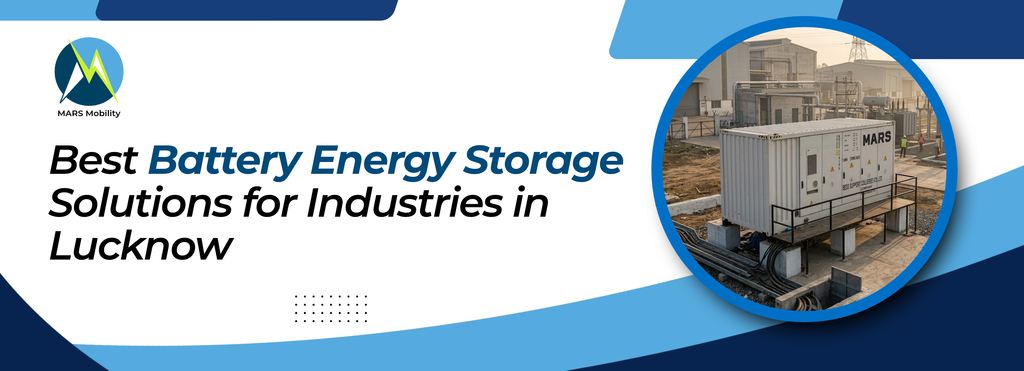
Battery Energy Storage Solutions for Industries in Lucknow is moving up the agenda as the city grows into a commercial and industrial clean energy market. Factories, hospitals, data centres and large commercial buildings want steady power, lower peak-hour bills and better use of their rooftop solar. This guide explains why battery energy storage for industries in Lucknow makes sense now, which sites benefit most, how to size a system and what to ask suppliers. It also covers how a BESS in Lucknow can be supplied and serviced by Mars Energy & Mobility from neighbouring Kanpur.
Why Lucknow Industries Are Looking at Battery Storage
Lucknow is already a solar leader. According to Mercom (8 October 2026), Lucknow was India’s leading district for residential rooftop solar installations as of 15 April, ahead of Surat, and it is one of the Solar Cities named under the UP Solar Energy Policy 2022. Mercom also describes the city as an emerging C&I clean energy market.
Three trends push businesses towards energy storage solutions in Lucknow:
- Record demand. Uttar Pradesh recorded a peak demand of 32,348 MW, above Maharashtra’s previous record, per the same Mercom report. High peaks put pressure on supply in the busiest hours.
- Time-of-day pricing. UP’s FY 2026-27 tariff order keeps a 15% rebate and a 15% surcharge for industrial and commercial consumers at set hours, as summarised by PowerPeak Digest. Storage lets a site buy cheaper power and use it in costly hours.
- Data centre growth. The UP Data Center Policy 2026 plans clusters in Lucknow and other cities, targeting 2 GW of capacity, with incentives linked to renewable energy use.
Taken together, battery energy storage for industries in Lucknow is no longer a niche idea. Planning battery energy storage for industries in Lucknow alongside solar or a new connection avoids paying twice for site work.
Who Needs Battery Energy Storage for Industries in Lucknow?
| Site type | Main problem | What storage does |
| Manufacturing units, such as those in Chinhat | Peak-hour surcharges, production stops during outages | Shifts energy to cheaper hours, keeps critical lines running |
| Data centres and IT parks | Equipment that cannot go down, renewable targets | Supports backup and stores solar for later use |
| Hospitals and diagnostic centres | Critical equipment and patient safety | Keeps critical loads online during outages |
| Malls, hotels and offices | High daytime bills and generator use | Cuts peaks and stores rooftop solar |
| Food processing and cold storage | Temperature-sensitive stock | Bridges outages and lowers peak demand |
For most of these sites, industrial energy storage in Lucknow pays off in two ways: lower bills and fewer stoppages. A manufacturing unit gains most from tariff shifting, while a hospital or data centre values continuity first. Industrial energy storage in Lucknow should therefore be designed around the site’s main goal. In every case, battery energy storage for industries in Lucknow works best when sized from real load data.
Data Centres and Renewable Targets in Lucknow
Data centres are a major new load planned for the city. The UP Data Center Policy 2026 targets 2 GW of capacity and investment above ₹2 trillion, with clusters planned in Lucknow, according to Mercom. An earlier Mercom report (28 September 2026) adds that the policy targets 50% renewable consumption by new data centres by 2030 and offers a 75% exemption on wheeling and transmission charges for 25 years for in-state renewable power.
Solar cannot run a data centre after sunset, so storage becomes part of the renewable plan. Battery energy storage for industries in Lucknow lets these sites hold renewable power and use it when solar is not generating. For developers, planning battery energy storage for industries in Lucknow at the design stage is simpler than adding it later.
What a BESS Does on a Lucknow Site
A battery energy storage system (BESS) stores electricity and releases it on demand. On a Lucknow site, it usually does four jobs:
- Tariff shifting: charge in the 15% rebate window, discharge in the 15% surcharge window
- Peak cutting: supply short demand spikes from motors, chillers and compressors
- Continuity: keep critical loads running during outages
- Solar storage: hold surplus rooftop solar for evening use
Our industrial battery storage guide for Uttar Pradesh includes a worked example of the ToD saving. A BESS in Lucknow can combine these jobs, with software deciding when to charge and discharge. That is why battery energy storage for industries in Lucknow is usually planned as one system serving two or three goals.
How to Size Storage for a Lucknow Site
Sizing starts with data. Before asking for a quote, collect:
- 12 months of electricity bills, with ToD-wise consumption if shown
- Peak demand in kVA or kW and when it occurs
- The loads that must never stop
- Existing rooftop solar or DG capacity
- Indoor or outdoor space available
Next, check when your peak use falls against UP’s ToD windows for industrial and commercial consumers:
| Season | 15% rebate | 15% surcharge |
| April to September | 7 AM to 4 PM | 7 PM to 2 AM |
| October to March | 10 PM to 4 AM | 6 AM to 10 AM, and 5 PM to 7 PM |
Battery energy storage for industries in Lucknow should be sized to cover the surcharge hours that matter most to your shift pattern. Then match the site to a size band:
| Site size | Typical need | Mars option |
| Small units and clinics | Backup for critical loads | Stackable Tower (4.8 to 21.3 kWh) or MB-ESS-LFP rack systems |
| Mid-size factories, hospitals and malls | Daily tariff shifting and peak cutting | C&I series (86 to 253 kWh configurations) or MBF200 (215 kWh to 2.58 MWh) |
| Large plants, campuses and data centres | MWh-scale storage | Containerised BESS (2.0 to 6.25 MWh) |
The right energy storage solutions in Lucknow are sized first for the main goal, then checked for backup. Industrial energy storage in Lucknow that is oversized ties up capital, while an undersized system leaves savings unused. Getting battery energy storage for industries in Lucknow right starts with a site survey.
Mars Energy Storage for Lucknow, Built in Kanpur
Mars Energy & Mobility manufactures LFP-based storage in Dada Nagar, Kanpur, close enough to support a BESS in Lucknow with local engineering and service.
C&I energy storage system, as listed by Mars:
- Indoor Series, Outdoor Units and the Powervault range, from 86 kWh to 253 kWh, with the MBF200 scaling from 215 kWh to 2.58 MWh
- Lithium iron phosphate (LFP) cells and an Energy Management System engineered in-house
- IP54 protection, a -20°C to 55°C working range, integrated thermal management and heptafluoropropane fire suppression
- A 10+ year lifespan, as stated by Mars
Containerised BESS for large sites:
- 20 ft and 40 ft containers, 2.0 MWh to 6.25 MWh and 0.5 MW to 2.5 MW
- Round-trip efficiency of 87% or higher, IP55 outdoor rating and aerosol-based fire suppression
- RS485, CAN and Ethernet (Modbus RTU/TCP) communication
Mars states that it commissioned the first utility-scale BESS in Telangana at SCCL, Mandamarri, and its BESS approach runs from site assessment and design to commissioning and ongoing maintenance. In March 2025, IIT Kanpur signed an MoU with Mars Antennas & RF Systems Pvt Ltd to develop smart hybrid inverters for energy storage applications. For buyers comparing energy storage solutions in Lucknow, a manufacturer next door makes a BESS in Lucknow easier to install and service. Mars can design battery energy storage for industries in Lucknow from your load data, so the system matches how your site actually uses power. A well-designed battery energy storage for industries in Lucknow project starts with that survey.
Questions to Ask Before You Buy
- What cycle life does the battery offer, at what depth of discharge?
- Which BMS protections are included: overcharge, short circuit, over-temperature, overload and deep discharge?
- Is the energy management software developed in-house?
- What fire suppression and cooling are built in?
- How quickly can the service team reach your site?
- Are warranty and performance terms written down?
A supplier who answers these clearly will deliver industrial energy storage in Lucknow that lasts. Choosing industrial energy storage in Lucknow from a nearby manufacturer also shortens the response time when something needs attention. For larger projects, ask for a site survey and a written proposal for battery energy storage for industries in Lucknow before you commit.
Frequently Asked Questions
Is battery storage worth it for Lucknow industries?
For sites on time-of-day tariffs, with outages or with rooftop solar, storage can cut bills and protect production. A load study shows the value for your site.
What size BESS in Lucknow do I need?
Small units can start with Mars’s Stackable Tower (4.8 to 21.3 kWh). The C&I series covers 86 kWh to 253 kWh for mid-size sites, and large campuses need MWh-scale systems.
Can storage work with rooftop solar in Lucknow?
Yes. Energy storage solutions in Lucknow can hold midday solar for evening and night use.
Is LFP safe for industrial use?
LFP is one of the most thermally stable lithium chemistries. Safety also depends on the BMS, cooling and fire suppression.
Who supplies battery energy storage for industries in Lucknow?
Mars Energy & Mobility supplies energy storage solutions in Lucknow from its Kanpur factory. Contact the team or call +91-7991262620.
